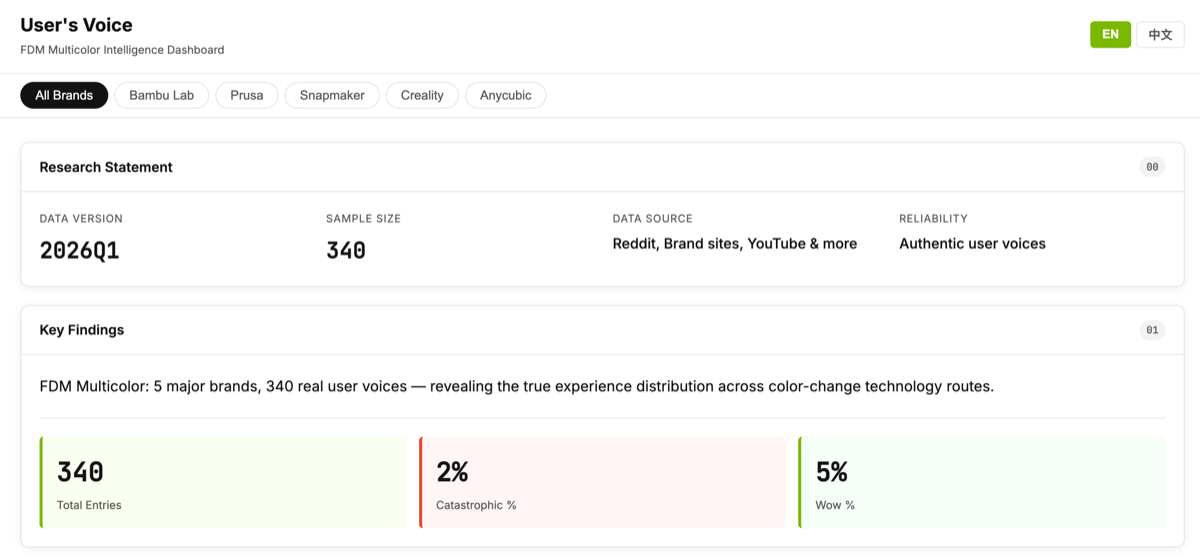
Prusa users want to throw their hardware out the window. Bambu Lab users just worry about their wallets. This isn't a standard brand rivalry. It is a generational replacement of product philosophies. You see the shift in the data, not the marketing.
Open Source is a Moat Until the Product Fails
Prusa was the spiritual totem of open-source 3D printing. In 2012, Josef Prusa designed the i3 in a Prague apartment with zero VC funding. He moved hundreds of thousands of units purely on community momentum. But sentiment doesn't stop history. My attribution analysis shows 20% of Prusa users are "Brand Believers." They pay for the ideology. They tolerate defects because they feel like co-creators, not just customers.
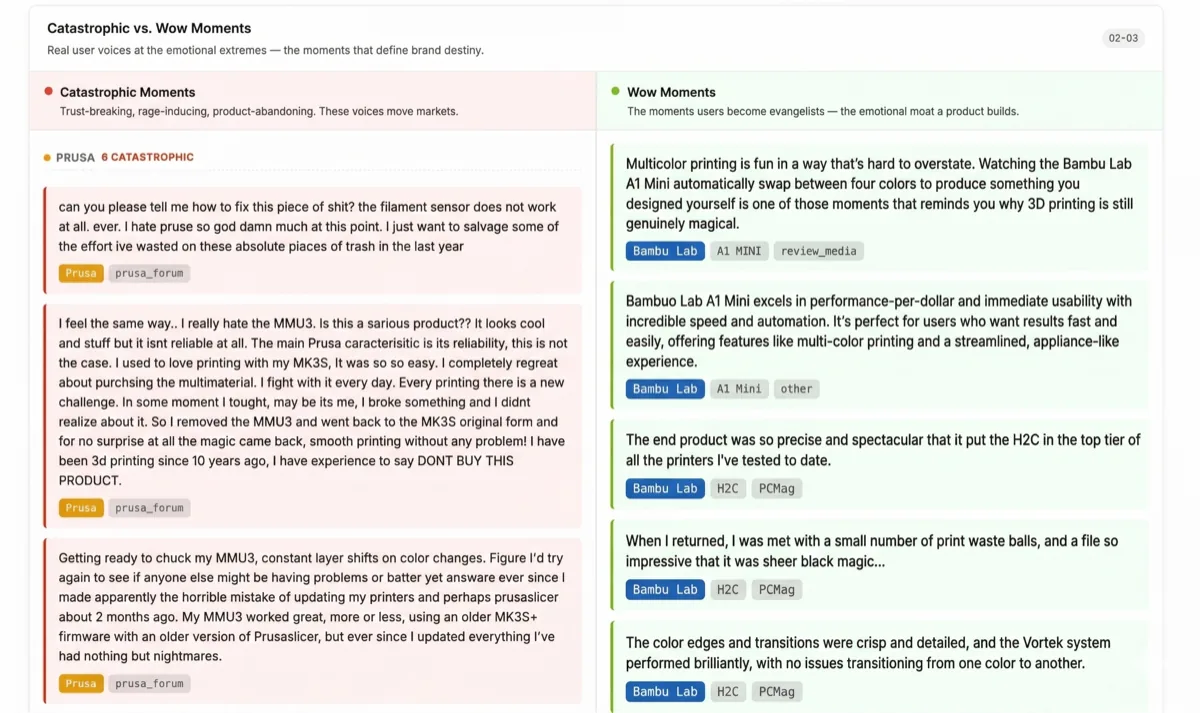
That tolerance has a hard ceiling. When the MMU3 (Multi-Material Unit) fails repeatedly, the "co-creator" becomes a frustrated repairman. I analyzed 60 valid reviews for Prusa. 22 were negative. 6 of those—exactly 10%—described total psychological collapse. Users didn't just report a bug; they threatened to destroy the machine.
"I have been 3D printing for 10 years. DONT BUY THIS PRODUCT," one wrote. Another was more visceral: "This issue has been so frustrating it makes me want to take my MMU3 and throw it through a window."
When your moat is built on faith, a technical failure is treated as a betrayal. 10% of your core users wanting to smash your product is a terminal metric. You can't patch a betrayal with a firmware update.
Efficiency Loss is Better Than Systemic Collapse
Bambu Lab has no "faith" buffer. As a Shenzhen company founded in 2020, it faces a decade of Prusa's community loyalty and a thick layer of "Made in China" skepticism. Their only weapon is raw product utility.
The data reflects this—but not in the direction you'd expect. In 62 valid reviews for Bambu, 29 were negative. That is a higher raw complaint rate than Prusa. On the surface, Bambu looks worse.
This is where sentiment volume misleads you. The relevant metric isn't how often users complain. It's how hard they collapse when they do. I call this emotional intensity: the degree to which a failure ruptures the user's relationship with the product. On that dimension, Bambu's Collapse Count was 0. Not a single user described a desire to destroy the machine.
The core issue for Bambu is "Efficiency Loss," affecting 30% of their negative feedback. Users complain about filament waste and high consumable costs. This is economic friction, not systemic failure.
Two distinct failure modes:
Systemic Collapse (Prusa): The machine stops working. You lose your weekend. You want to smash it.
Economic Loss (Bambu): The machine works, but it's expensive to run. You lose money. You complain about the bill.
Filament waste can be calculated and tolerated. A collapsed user relationship cannot be recovered with a coupon. This is why Bambu wins. They traded mechanical complexity for a wasteful but stable pragmatic compromise—and users accepted that trade.
Geopolitics is the Last Refuge of the Uncompetitive
In February 2026, Josef Prusa gave his "Eastern Threat" speech. He accused Chinese companies of "stealing" the industry. MMU3's systematic negative reviews had already accumulated through late 2025. The timing of this speech is not a coincidence. When a founder pivots the conversation from "First Layer Calibration" to "Data Sovereignty," they are admitting the product war is lost.
Geopolitics is a mirror of declining competitiveness. It is an unfalsifiable narrative used to distract from a jammed extruder. If the MMU3 worked 99.9% of the time, no one would need to talk about where the motherboard was soldered.
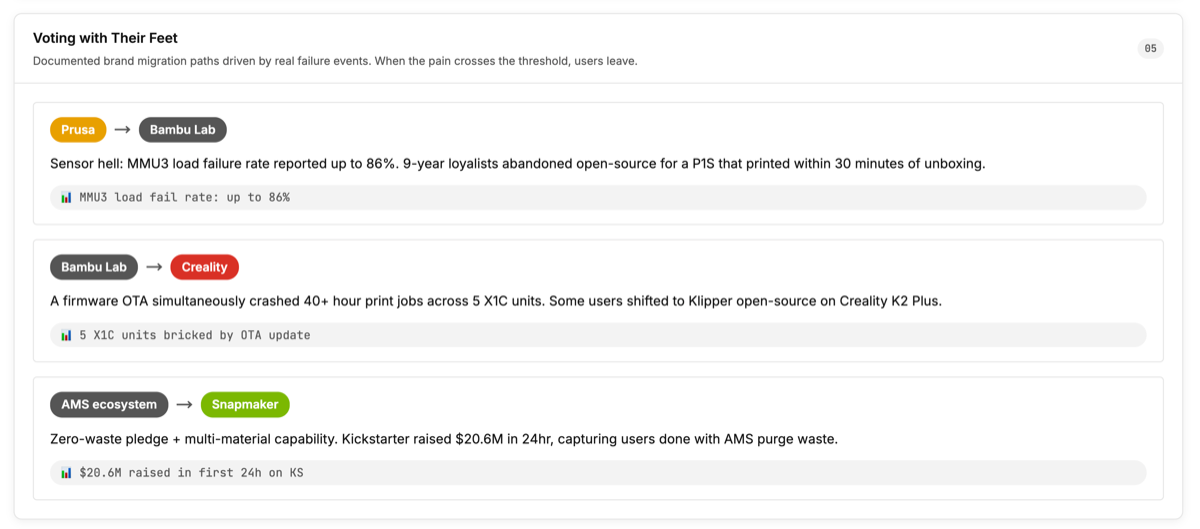
The users have already moved on. In Reddit buying guides, the consensus has hardened: "If you want to tinker, buy Prusa. If you want to print, buy Bambu." The subtext is clear. Open-source spirit is a luxury. A successful 12-hour multi-color print is a necessity.
Clever Engineering Killed the MMU3
The MMU3 failed because it was too clever. It tried to solve multi-color printing with extreme mechanical ingenuity and tight tolerances. It is an "interesting" solution. In hardware, "interesting" is often the enemy of "reliable."
Bambu's AMS (Automatic Material System) is a brute-force solution. It wastes more plastic, but it closes the logic loop of the user's intent: I want this file to become a physical object without me touching it. Prusa asked its users to do the work its engineers couldn't finish. That's not a community. That's unpaid QA.
10% of users being "ready to smash" is not a vocal minority. It is the sound of a paradigm shifting.
340 data points. Open-source spirit is worth respecting. Users won't pay their repair bills with it.
6 smash events vs. 0 breakdowns. The vote is over.
lemon.wang | hi@lemon.wang
Note on Data: This analysis is based on 340 user comments from the Reddit r/3Dprinting community as of March 2026. Samples include Bambu Lab, Prusa, Snapmaker, Creality, and Anycubic.
Source: Data processed via User's Voice, an intelligence tool for the 3D printing industry.
- FDM Multi-color: fdm-multicolor.usersvoice.lemon.wang
- iNew3D Full Color: inew3d.usersvoice.lemon.wang