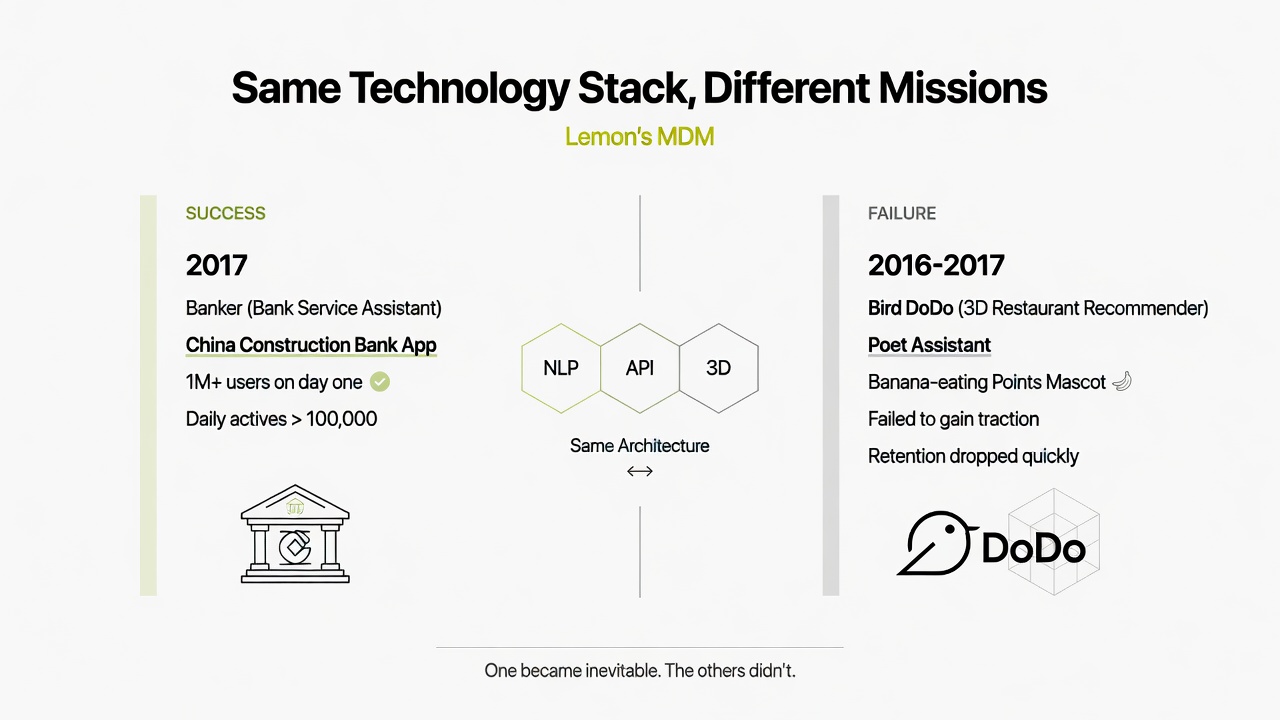
In 2017, a bank service assistant called Banker launched inside China Construction Bank's app and hit over one million users on day one, with daily actives staying above 100,000. (Internal data, CCB app launch, 2017.)
The same exact technology stack — early NLP, word vectors, and location APIs — had already failed three times: Bird DoDo, a 3D restaurant recommender; a poet assistant; a banana-eating points mascot.
My team and I burned six months and significant budget chasing the wrong missions before we finally understood: the technology was never the problem. The mission fit was.
When Demand-Driven Works — and When It Doesn't
When the market is clear and demand is well-understood, the traditional demand-driven approach works: deep user research, extract needs, refine features, build the flywheel.
But in deep tech, early AI, and hardware, the technology is often powerful before the best application is obvious. Starting purely from user requests means optimizing for visible problems while missing where the technology creates real, unfair advantage.
User research is a precision tool in a clear market. In ambiguous territory, it often becomes a trap for self-confirmation.
This is where Lemon's Mission Definition Method (MDM) becomes useful.
What is Lemon's MDM?
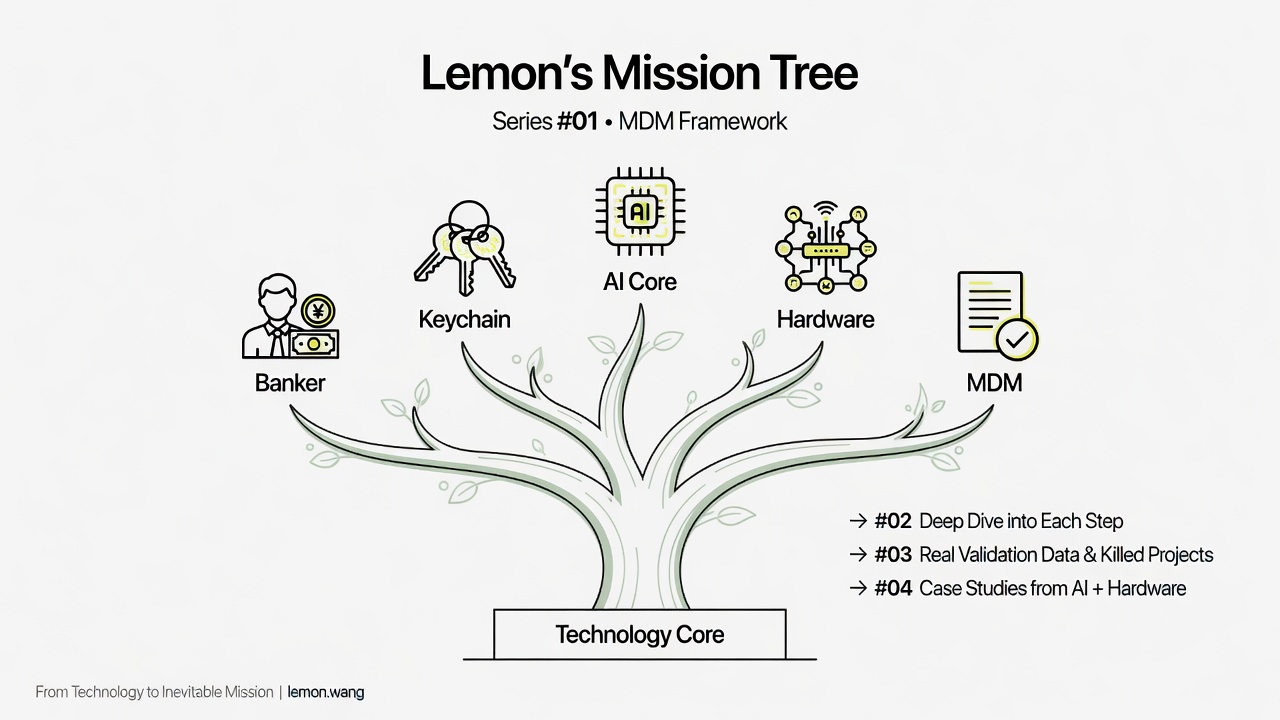
Lemon's MDM is a first-principles framework that starts from the technology's core capabilities, systematically explores multiple mission-aligned scenarios, validates them with real behavior data, and forces clear retain / freeze / exit decisions.
The goal is not to find "a" product.
The goal is to find the mission where your technology feels inevitable.
The Five Steps
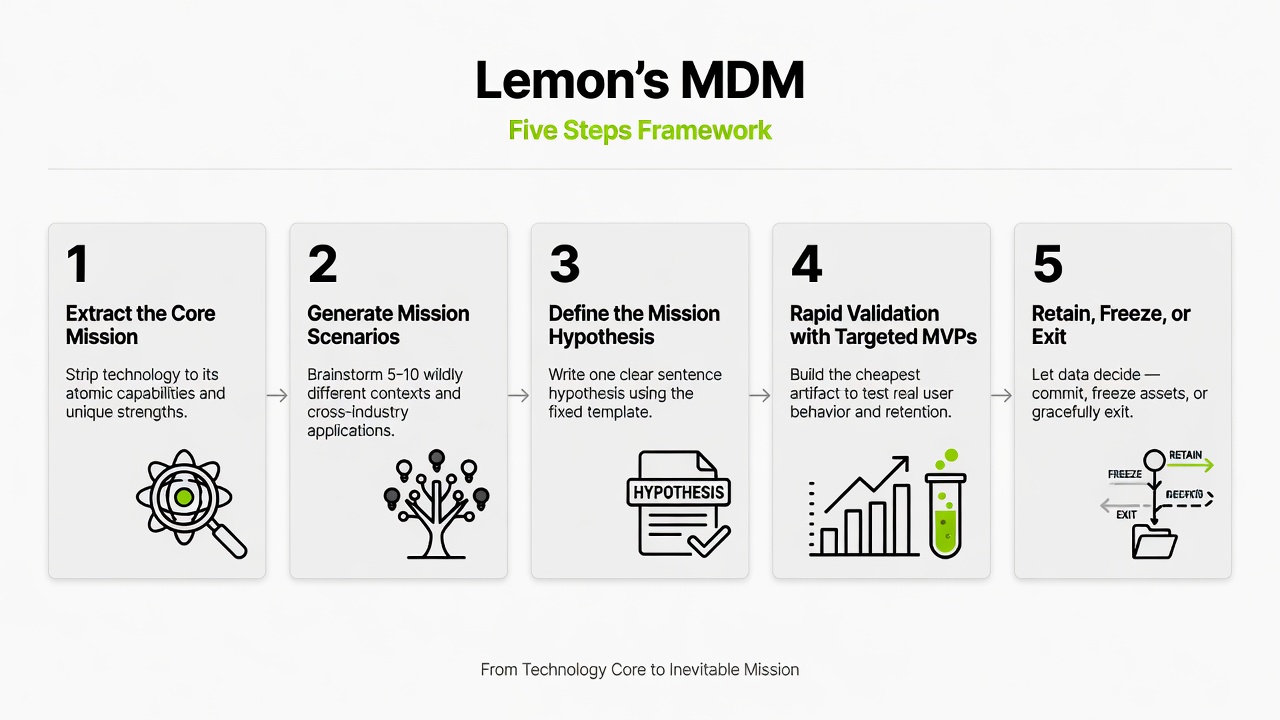
1. Extract the Core Mission
Strip the technology to its fundamentals. What can it uniquely do that others struggle to replicate? What are its hard constraints?
Questions to ask:
- Where can this tech deliver 5× speed, 50% lower cost, or an outcome competitors cannot match?
- What are the non-negotiable physical or computational limits?
- If you ignored all existing markets, what problems does this technology naturally want to solve?
2016 example: Our core was "parse natural language intent and match it with nearby real-world services via structured APIs." That single definition opened four completely different mission directions.
2. Generate Mission Scenarios
Brainstorm 5–10 distinct verticals where that core mission creates outsized value. Don't start with adjacent markets — they are the obvious trap.
Questions to ask:
- What if this technology served a user with completely opposite goals?
- Which industries are still solving this problem with entirely manual or inefficient methods?
- Where does the technology's constraint accidentally become an advantage?
Practical rule: Force at least 3 cross-industry directions. The right mission is rarely in the first market you think of.
3. Define the Mission Hypothesis
One sentence. Fixed template:
"This technology exists to help [specific audience] turn [X] into [Y], so they can [core outcome]."
班克 version: "This technology exists to help bank customers turn their location and financial needs into personalized nearby services, so they save time and make better daily decisions."
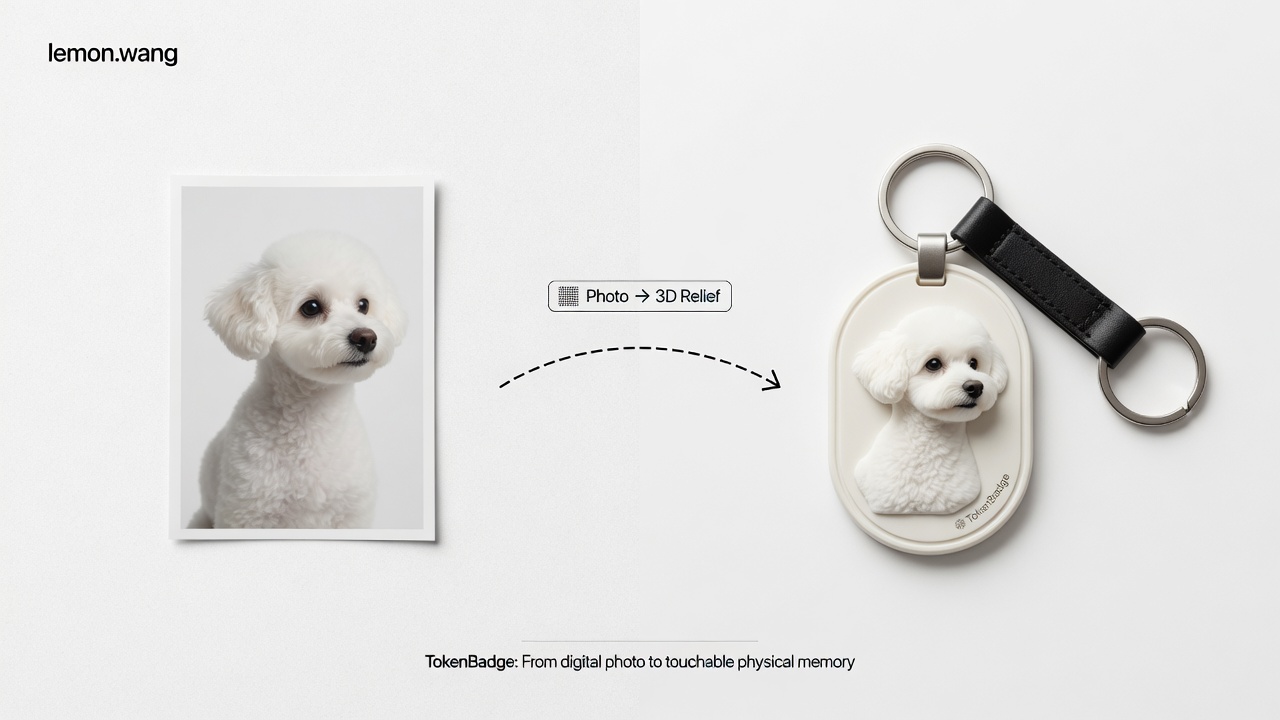
TokenBadge version: "This technology exists to help pet owners turn personal photos into permanent physical objects, so emotional memories become touchable and shareable."
4. Rapid Validation with Targeted MVPs
Build the cheapest artifact that tests real behavior — not opinions. Measure retention and willingness to pay, not survey responses.
TokenBadge validation: I posted sample photos on WeChat Moments. Orders came in before I finished writing the caption. The first customer ordered four pieces — one keychain for each of their dogs. I capped it at 20 units due to supply chain constraints. That cap was the validation: demand existed before infrastructure did.
Pre-set your kill criteria before you build. By week six, you will have fallen in love with the direction regardless of what the data says.
Example kill criteria: Retention below 30% at week four, or zero willingness-to-pay signal in early tests — freeze or exit immediately.
5. Retain, Freeze, or Exit
Let the data decide. But "exit" doesn't always mean delete.
Most weak directions go into a freeze state — kept alive at minimum cost, technical assets preserved. A frozen project's architecture, user insights, and production learnings flow directly into the next direction. Nothing is wasted. The mission was wrong. The technology asset remains.
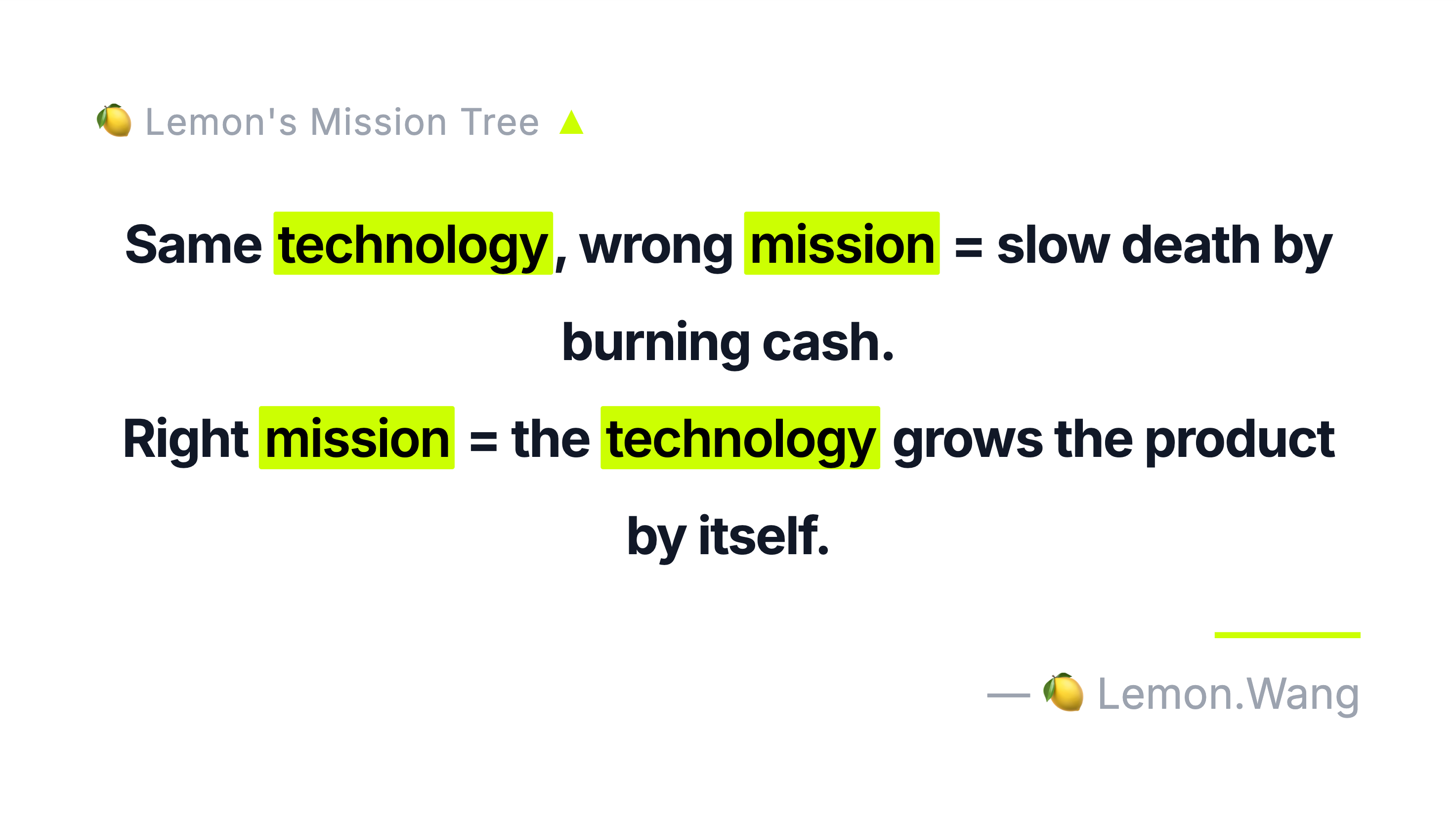
Same technology, wrong mission = slow death by burning cash. Right mission = the technology grows the product by itself.
The Pattern Repeats
I later applied MDM to AI 3D + 3D printing technology and ran five directions simultaneously:
- TokenBadge: Personal photos → touchable 3D relief keychains. Demand validated in hours via a single WeChat post.
- Source·源: Life moments → permanent titanium objects. High willingness-to-pay, supply chain sequencing required.
- BoBoBlob: AI + handcraft hybrid kit for family education.
- Machine Heart Kit: Light, sound, vibration embedded into 3D prints for smart hardware core.
- MakerCore: Maker commercialization — idea to market-ready product pipeline.
Five directions. Five different customer psychologies. MDM surfaced the differences before heavy investment, not after.
The fastest path from 0 to 1 is never owned by the team with the best technology. It belongs to the team that found the right mission first.
In the next articles of this series, I will break down each MDM step in detail — including the exact validation data, the directions we froze, and why.
If you are building with powerful but directionless technology, drop your core tech and the missions you are considering in the comments.
MDM isn't about picking one product. It's about cutting every road where your technology is merely useful — and keeping only the one where it becomes inevitable.
#01 · METHODOLOGY · Lemon's Mission Tree