The machine is now the cheapest thing in the room.
This week at TCT Shenzhen, Formlabs launched the Form Studio 1 in China. Everyone was talking about one number: $699.
The number that stayed with me was different: $199. That's the Wash+Cure post-processing station — a third of the printer's price, and you can't skip it. Resin runs $29 a litre. Third-party 405nm materials are welcome. The machine itself is the cheapest link in the chain.
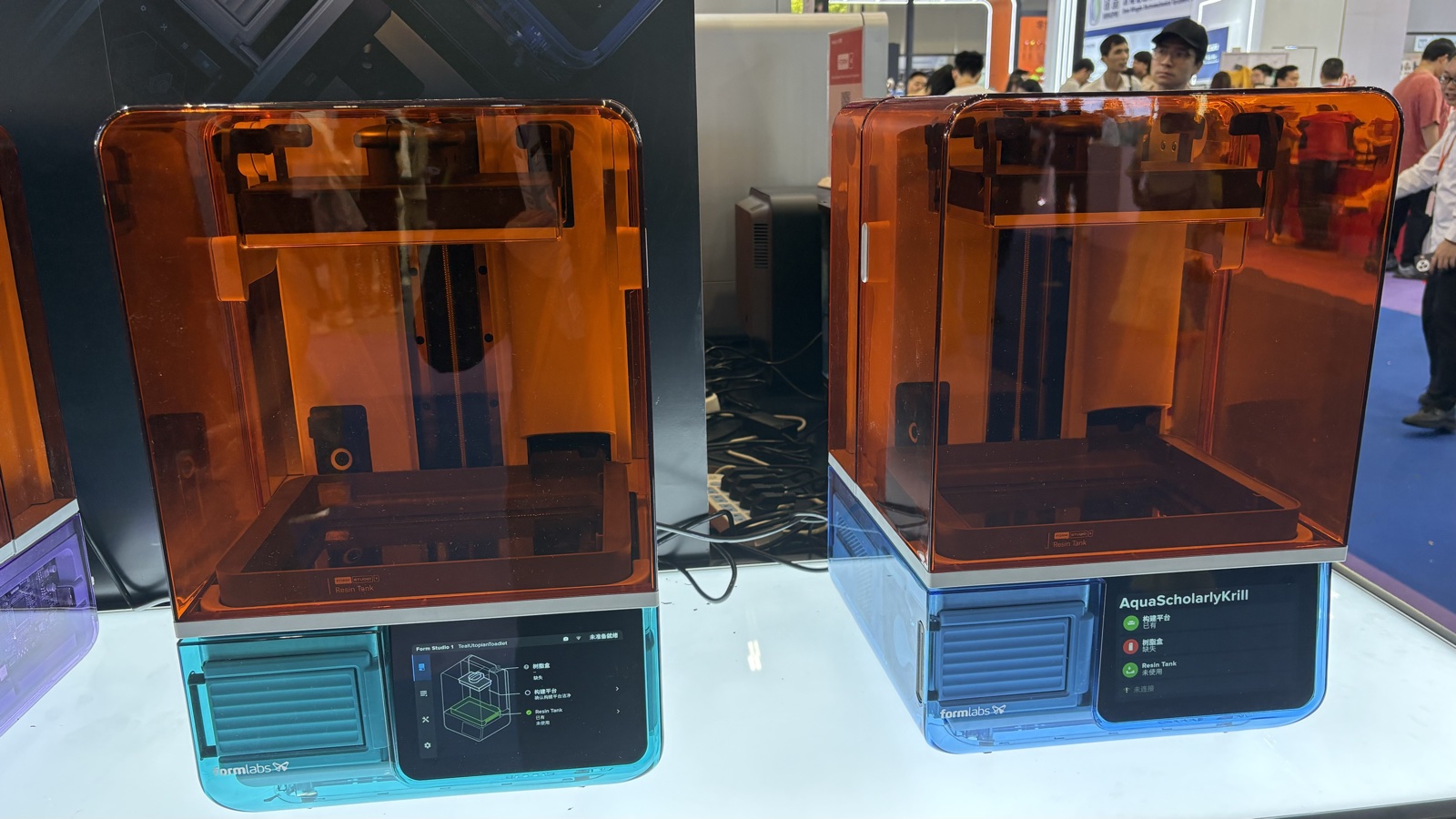
Once a printer is too cheap to be the product, the battlefield moves.
Professional printing won't die. It sells material systems, repeatable precision, certification — things a $699 box can't give and won't replace. What dies is the middle ground: the $2,000 machines that offer nothing but the machine.
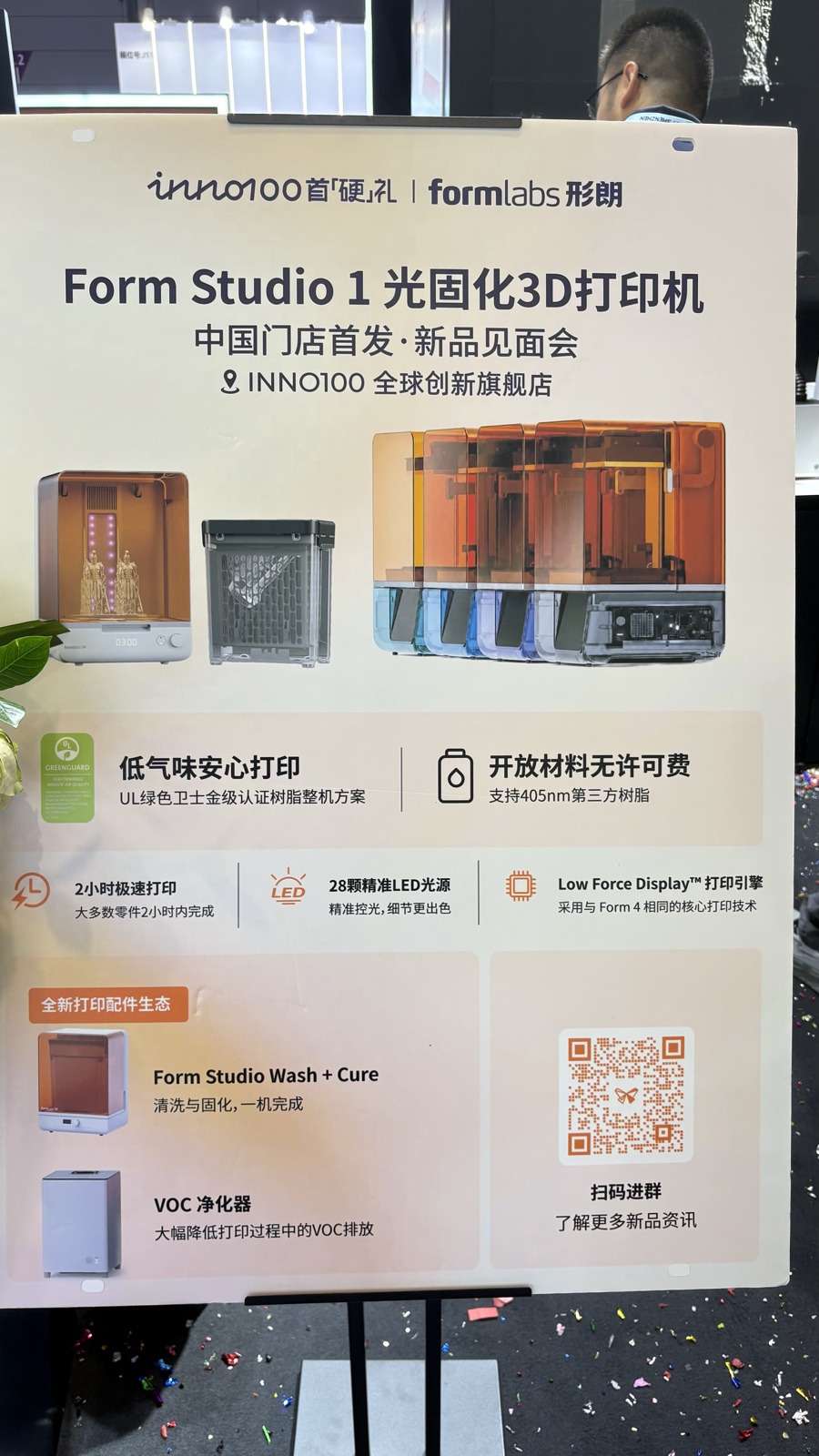
Two things at the booth were more honest than the keynote. The China launch didn't run on hype — it ran on INNO100's flagship store plus JD.com, so it could close sales on day one. And the poster carried a line Formlabs five years ago would never have printed: "Open materials. No license fee. Third-party 405nm resins supported."
Four ways to bet
For months I've been drawing one picture: how desktop brands are betting on the fact that hardware is no longer worth much.
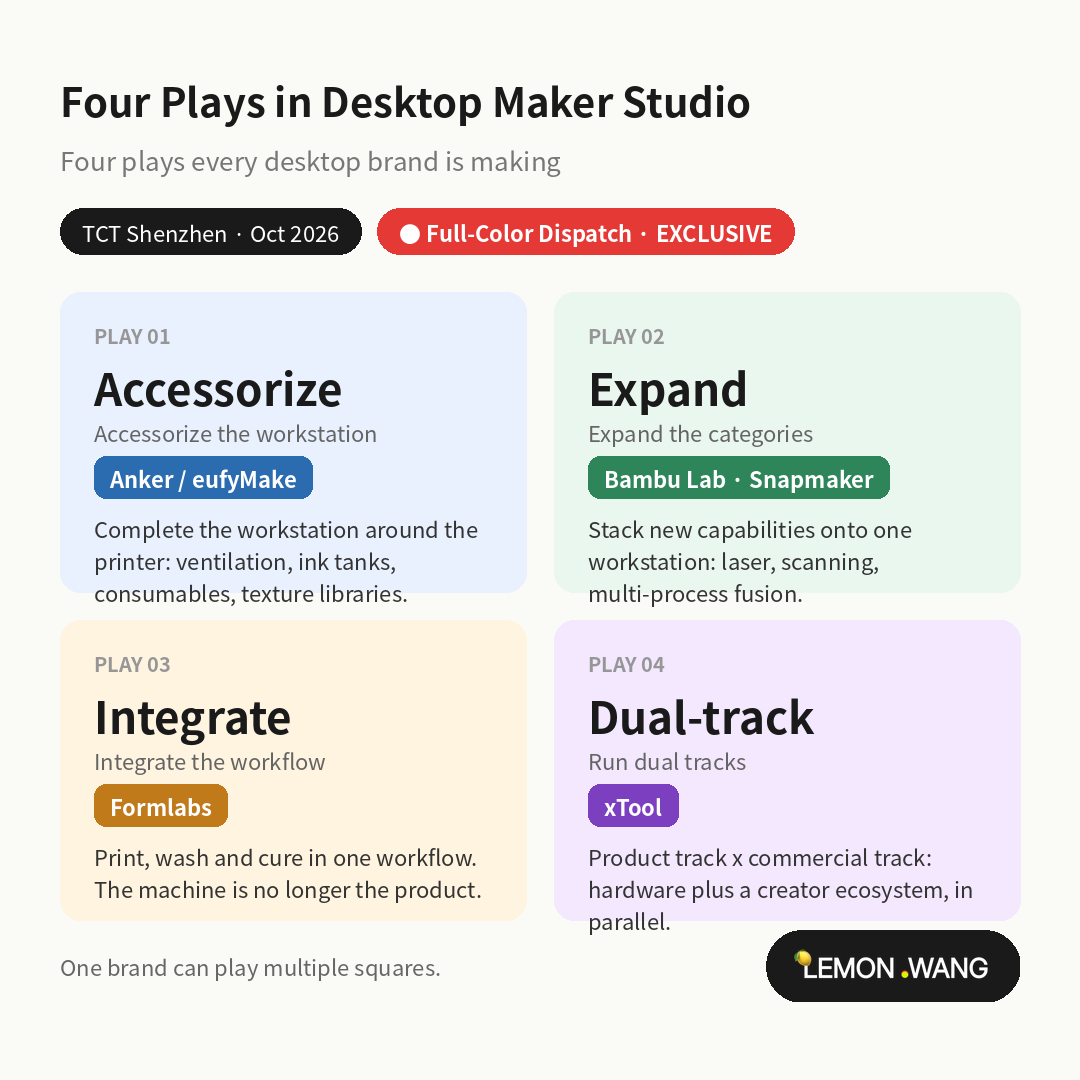
I group them into four plays. The boundary matters — these boxes hold plays, not brands. A brand can bet on more than one cell, and it's migrating (next section).
Accessorize — when the machine won't sell, sell around it. Anker is the case study: not enough ink tanks, add models; users hate the smell, add a VOC system. Walk this far enough and you're not in the machine business anymore. You're in consumables.
Expand — jump from your core category to the adjacent one. Bambu took FDM as far as it goes, then crossed into laser cutting (the R1, a CO₂ 55W). The logic is simple: sell the second and third machine to the same user.
Integrate — don't expand sideways. Collapse the chain — print → wash → cure — into one system. Formlabs is the reference: a $699 printer, a $199 Wash+Cure, $29/L resin, a 45-material library. The workflow is the product.
Dual-track — run a product track and a commercial track in parallel. xTool sells hardware while building Atomm, a content/templates/revenue-share operating system — a second layer on top of the hardware.
The four plays differ not by brand but by what each is expanding: accessories, categories, steps, or the business model.
This framework isn't a hunch. SprintRay runs a deeper version of Integrate chairside in dental clinics: NanoPrint, NanoWash, NanoCure — a six-minute loop. Its NanoWash sells for $1,999, more than Formlabs' printer, because of an RFID solvent tank that auto-matches wash curves and a "material isolation" mode that binds one tank to one resin to stop cross-contamination. In multi-colour printing, cross-contamination is the hidden cost — SprintRay solved it with material binding plus RFID.
Remember the signal: the washer costs $1,999 and the printer $699. The workflow is the product. The machine is the entry point.
Brands migrate
The static four cells are a snapshot. The truth is that brands migrate between them.
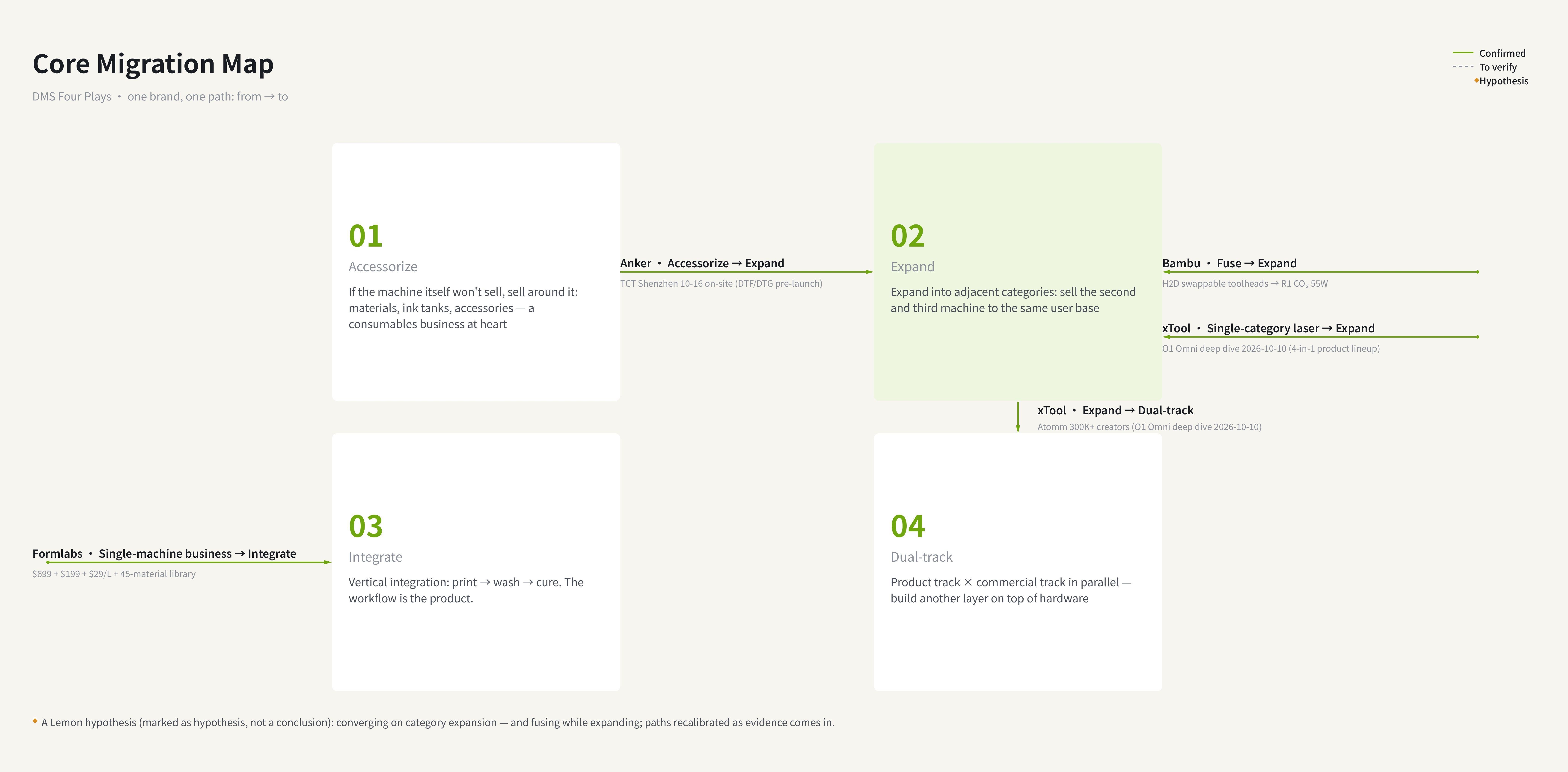
Anker is moving from Accessorize to Expand. At TCT it was pushing DTF/DTG fabric printers (pre-launch, plus co-creation partners) — crossing from "sell accessories around the machine" into "sell a second kind of machine."
Bambu is moving from Fuse to Expand. The origin is the H2D's swappable toolheads (FDM plus laser); the endpoint is the R1 CO₂ laser cutter. Jumping from FDM to laser cutting is a generational gap you can't finesse with software.
Formlabs is digging in place. No lateral expansion — it's taking Integrate as far as it goes. The direction is vertical, not horizontal.
xTool has already crossed twice. Laser single-category, then Expand, then Dual-track — running Atomm (300K+ creators across a four-in-one product line) alongside the hardware.
My bet: desktop brands converge on category expansion — and they fuse while expanding. Not one path. Several at once. That's a bet, not a conclusion. I'm leaving the picture up until the next trade show argues with it.
Five signals from the floor
Anker is overseas-first. Its ink tank already showed at IFA, but in China there's no sales and no marketing. Judge Anker by its domestic market and you'll misread it — the whole play is built for the Western maker market.
eufyMake differentiates at the material layer: soft white ink, hard white ink, wood-grain and leather-grain libraries. The 2.5D moat isn't the machine. It's the material library.
N4D is building a native AI 3D foundation model: one-click image-to-3D, MBTI blind boxes, pet memorials. That's "AI-generated 3D" landing in real applications — not a slide.
Polymaker is selling "material as application": Panchroma translucent lamps, a pure-TPU mesh flower. Not "better plastic specs" — "here's what you can make with this material."
And Ruiyin's RY9060 price ladder: ¥20K, ¥30K+, into the hundreds of thousands, up to ¥800K+, ink at ¥500 a litre. That ladder spans desktop to production — the middle ground is bigger than it looks.
Certification is the moat
Formlabs' real moat this time is GREENGUARD Gold, the UL indoor air quality certification. Note the condition: Alpha Resins and the VOC Extractor are a package — neither holds on its own.
A certificate turns "can I safely run this indoors?" from a customer's worry into a product's entry barrier. A $699 machine can be copied. The neither-without-the-other combination can't be reproduced from a spec sheet.
At the show I met TÜV Rheinland. Certification is becoming the competitive moat in desktop printing — whoever gets there first owns the "safety" mindshare.
The question
Back to where we started. After Formlabs' $699, desktop printing is no longer a race to the bottom on price.
The real question is what position you hold in the workflow — because that's the position a $699 machine can't copy.
Which link in the workflow will you defend?
Lemon Wang is a product manager specialising in hardware strategy and user research, with experience across consumer and professional 3D printing. She writes at lemon.wang.