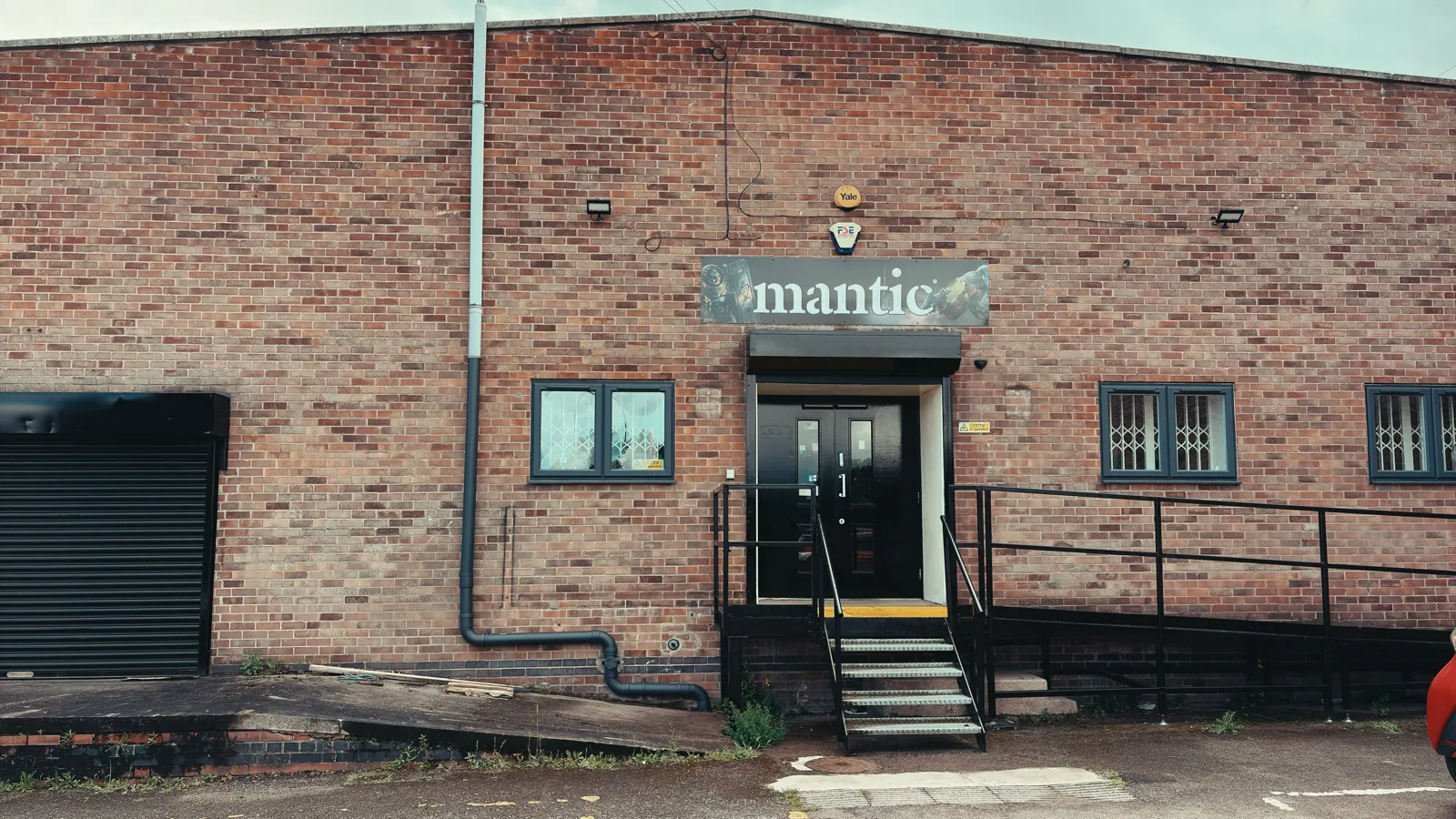
Last week I visited Mantic Games in Nottingham. The company behind Kings of War and the Halo Flashpoint tabletop game.
A few days earlier, I'd been at UKGE watching wargamers buy painted terrain at a 127% premium. The demand was already visible. The bottleneck was painting.
Their 3D print room has exactly two kinds of machine.
One German industrial DLP. €26,000. Precise. Expensive.
The other: Chinese desktop printers, £500 each — Elegoo and Anycubic, a rack of ten or so, all running at once.
"Same money, I can buy 20," the guy showing me around said. "And the quality's enough for what we need."
That sounds like a story about economy of scale. Cheap machines, good enough, buy in bulk. That's what they said too.
It isn't. I'm not even sure they've noticed the real reason.
Because the work those cheap machines do can't be done any other way.
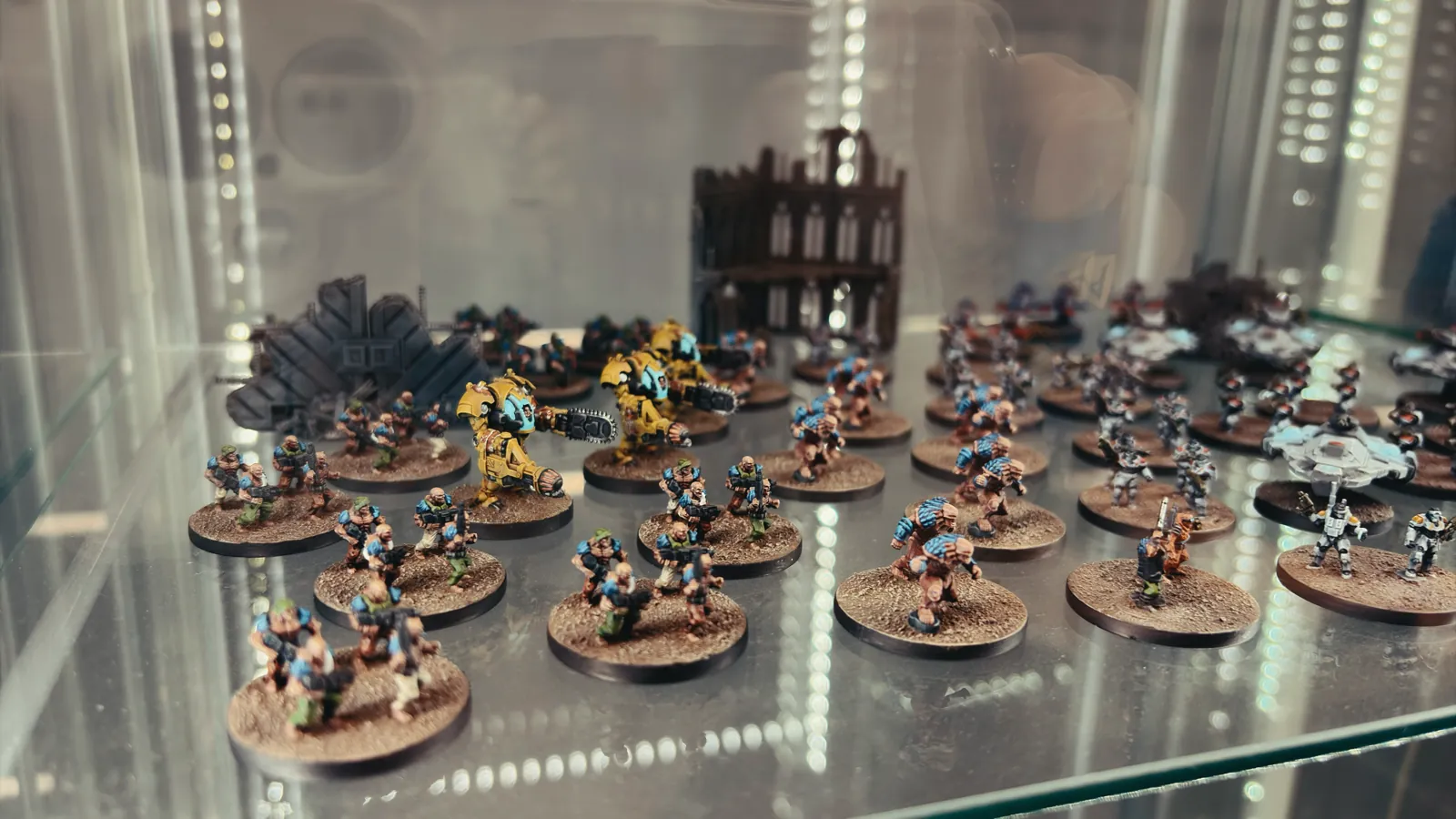
The miniatures on their shelves are tiny. 10mm — smaller than a fingertip. Mantic builds whole armies at this size.
You can't injection mold a 10mm figure. The tooling cost would never come back.
You can't hand-cast it either. Too small. It won't release from the mold cleanly, and you lose most of them.
So at this size, 3D printing isn't the cheaper option. It's the only option that makes the thing at all. The £500 machine isn't beating the €26,000 one on quality. It's the only thing in the room that can make this product, full stop.
Old manufacturing had two gears.
Injection: thousands of units minimum, and you bet a pile of tooling money up front against a sales forecast. Hand-casting: stuck at dozens, one skilled pair of hands pouring them one at a time.
The stretch in between — hundreds of units, fast turnaround, frequent design changes — was empty.
Not because nobody wanted it. Because no form of capacity could hold it.
Then a rack of cheap machines filled the gap.
And once the gap had capacity, the demand showed up. Whole armies at small scale. Terrain. Custom minis. A whole class of product that didn't exist before — because there was no way to make it at a price anyone would pay.
Demand isn't always sitting there waiting to be met. Often the capacity comes first, and the demand wakes up after.
This isn't a one-off. It's happening in three directions at once.
The models are getting smaller. Warlord Games packs a whole 15mm company onto one plastic frame — a single box is a fighting unit, and it sells. Mantic goes straight to 10mm. At that size hand-casting can't cope; printing is the only way. And the smaller the figure, the more of them an army needs.
The painting barrier is being dismantled by the industry itself. Contrast paints: one coat and you get depth, no trained hand required. Resin surfaces deliberately made matte so paint grips without a primer. The hobby is quietly turning "painting well" from a craft into a single motion. One more step and it's zero.
The people changed. In China, plenty of young players already own a 3D printer and just download a file and print it themselves. Abroad, the young player base is growing. And the older instinct — sitting down to spend two hours painting one figure — hasn't grown into the younger ones. That's structural, not cyclical.
More pieces. Smaller pieces. More people who neither want to nor know how to paint by hand.
Monochrome capacity has already proved the mechanism. For color, the wake-up hasn't happened yet.
Put the two halves together.
On one side, the market is moving toward "many pieces, small size, no hand-painting." On the other, a form of capacity has already shown that if the machines are cheap enough to rack and reliable enough to leave alone, you can make a demand exist that didn't before.
But that capacity stops at monochrome.
Color is still asleep.
Industrial full-color machines exist — around a hundred thousand dollars each, far too expensive to line up in a rack the way you do with home machines. Their economics were never built for racking. And a full-color machine at desktop price, within reach of an individual or a small studio, basically doesn't exist yet. The closest signal so far is iNEW3D's Kickstarter: real buyers, real anxiety, and a category still trying to define itself.
So you get a mismatch: the place that needs color most is exactly where color is least available.
At army scale, nobody's after sculpt detail. Mantic put it plainly: a big game with lots of models — like Kings of War — "doesn't want too much detail." Only the instantly recognizable licensed characters, The Walking Dead, Hellboy, are where "you want every detail." An army wants color — tell at a glance which side is which.
Color reads at any size. Sculpt detail doesn't read at 10mm. Hand-painting collapses in front of a hundred 10mm troopers, and full-color printing is strongest in exactly that band — where detail doesn't matter and color does.
That day at Mantic, I pulled out what I'd brought with me — full-color parts off our printers. One shot, color and all, no painting. He turned them over in his hand and said he'd expected them to be bad. They weren't.
But the part worth keeping is the first half: he expected them to be bad. A company that works with additive every single day still assumed full-color wouldn't hold up, right up until he held it. The demand is asleep not because the market turned it down, but because most people haven't noticed it already works.
The German machine is still there. Still runs.
But the floor belongs to the rack of £500 machines. Because at this size they aren't a compromise. They're the only answer.
The €26,000 one didn't lose to a better machine. It lost to a kind of demand it was never built to serve — a demand that only became visible once a rack of cheap machines made it first.
Color is next.
Key Takeaways
- Cheap desktop 3D printers are not just replacing expensive industrial machines. In Mantic's 10mm miniature line, they make products possible that older processes cannot make economically at all.
- Some demand does not pre-exist capacity. Once a cheap, rackable production method exists, new formats, smaller scales, and faster product cycles become commercially visible.
- Full-color 3D printing is strongest where sculpt detail matters less than instant visual readability: armies, terrain, and small tabletop pieces that collapse under hand-painting.
Field FAQ
Why did a £500 desktop printer beat a €26,000 industrial machine? Because the cheaper printers fit the job. Mantic needed rackable, low-cost capacity for tiny 10mm miniatures. The industrial machine was precise, but its economics were built for a different kind of demand.
What does this say about full-color 3D printing? Color is the next missing layer. Monochrome desktop printers already proved that cheap distributed capacity can create new miniature formats. Full-color printing can remove the painting bottleneck in the same part of the market.
Who is the likely buyer? Small studios, tabletop creators, and serious wargamers who need many small pieces to read clearly on the table without hours of hand-painting.