1,080 user voices. 9 brands. Reddit, brand forums, YouTube, Amazon. I expected print failure to be the dominant complaint. The data said something else: users are ready to quit before the first layer ever touches the build plate.
The Workflow Tax Nobody Talks About
Resin printing is not a device. It is a workflow. And that workflow has five gates.
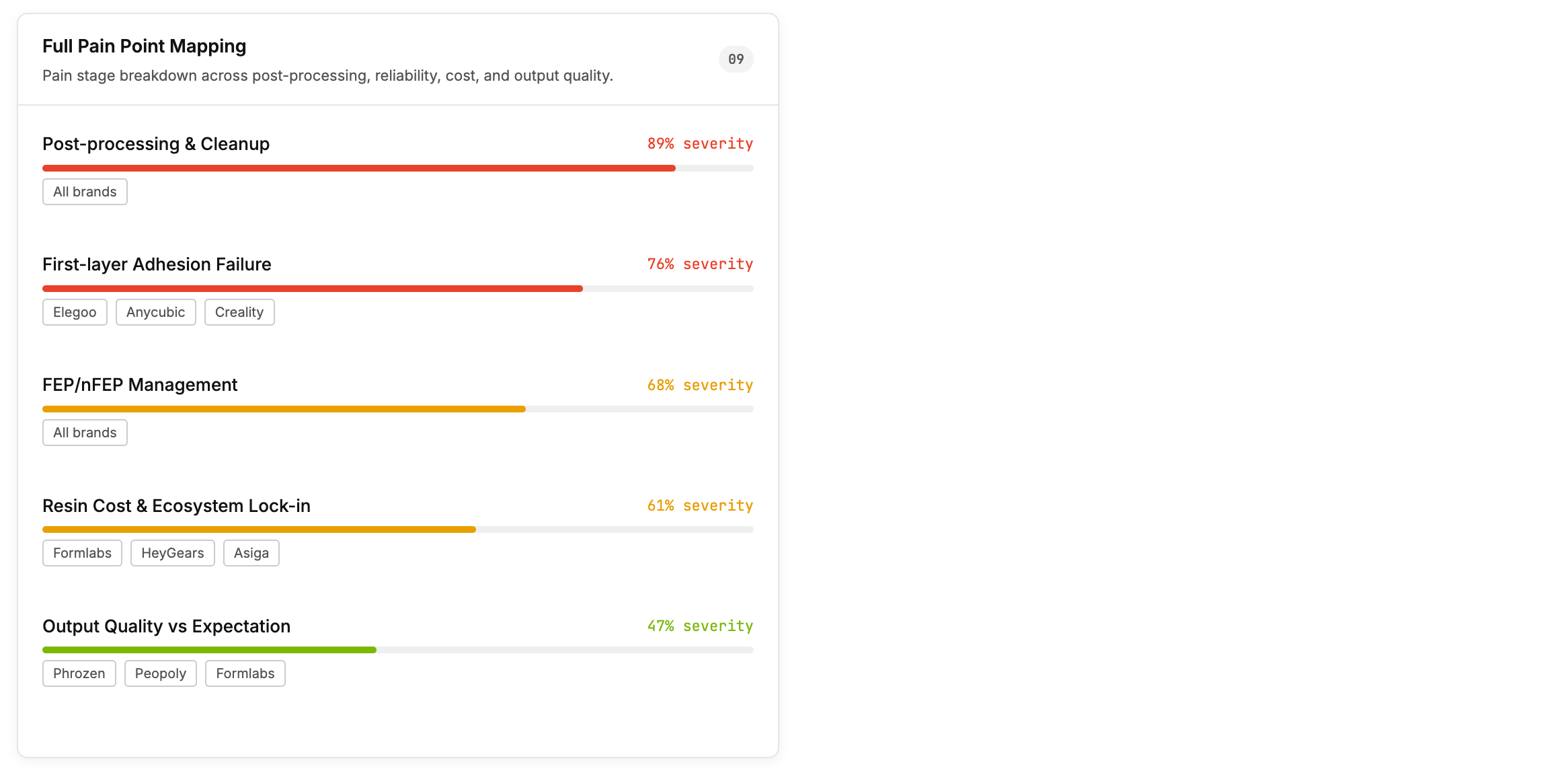
Post-processing and cleanup scores 89% severity — shared across every brand in the dataset. IPA rinse, secondary cure, resin overflow cleanup, FEP replacement. Users bought a tool for making miniatures and jewelry. They got a chemistry lab with a mandatory cleanup shift after every session.
This is not an edge case. This is the recurring cost of operating the machine. 89% severity means no brand has solved it, and no user has made peace with it. They tolerate it. That is not the same as accepting it.
The Machine Fails Before It Starts
First layer adhesion failure scores 76% severity, concentrated in Elegoo, Anycubic, and Creality.
When the first layer doesn't stick, the entire print is lost. Users can't diagnose whether the problem is leveling, FEP tension decay, or underexposure. They start adjusting exposure settings, swapping resin, and searching forums at midnight.
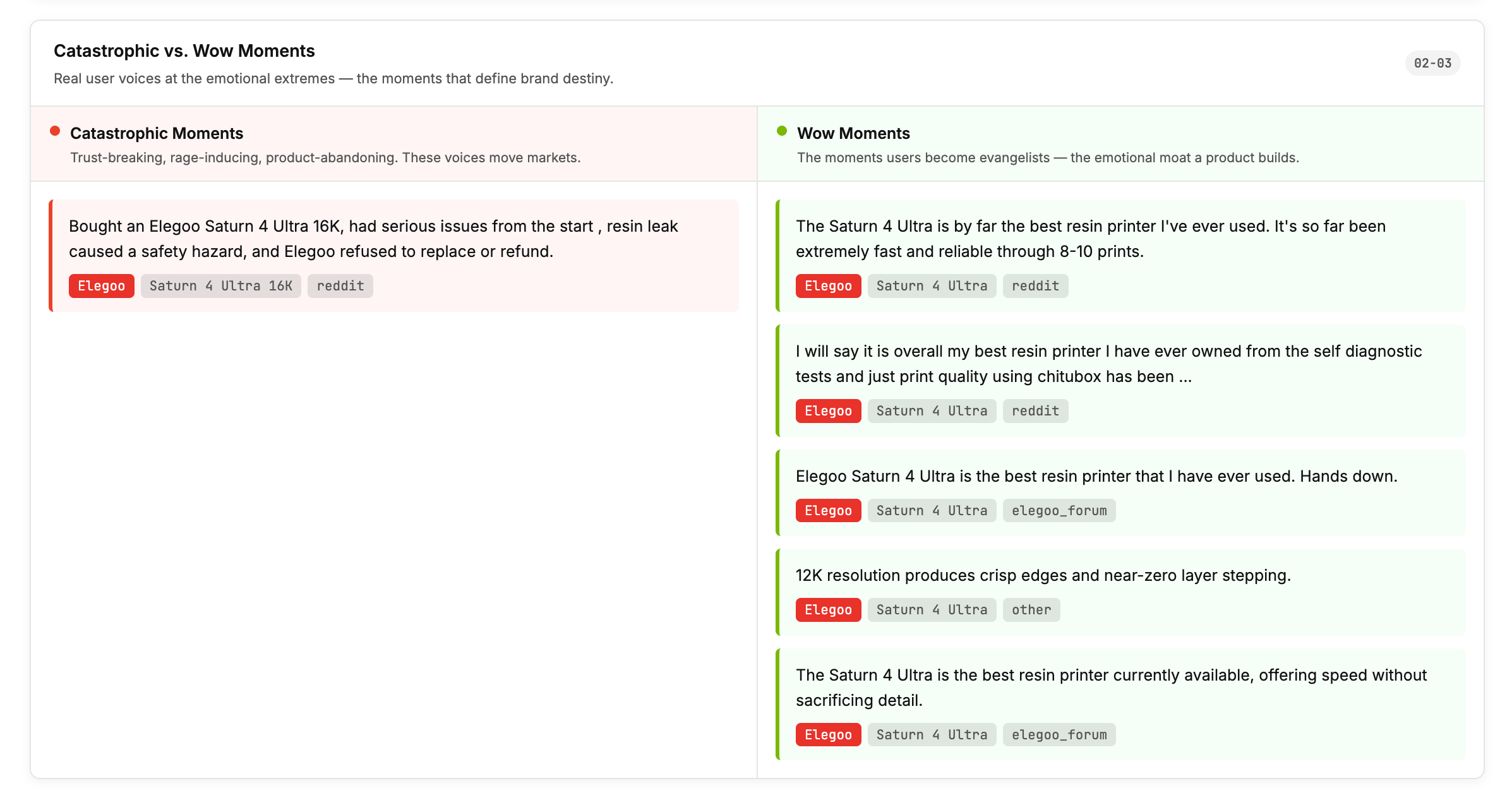
Elegoo Saturn 4 Ultra ships with an AI camera. Users were direct about what it does and doesn't do:
"The 'ai camera' isn't great. It doesn't actually detect failures."
"The AI camera unfortunately doesn't help with this either, which means you can be as far as an hour into a print before being able to tell if it has failed."
The camera recorded the failure. It did not prevent it. Surveillance is not the same as reliability.
The Hidden Consumable Nobody Prices In
FEP membrane management scores 68% severity across all brands.
FEP is a consumable. It degrades unpredictably. Replacement is fiddly. Users buying a resin printer are not told how frequently they will need to do this, or what it costs across a year of printing. By the time they find out, they've already committed.
This is not a hardware defect. It is a pricing and onboarding failure.
The Wall Is by Design
Resin cost and ecosystem lock-in scores 61% severity. The expression varies by brand positioning.
For consumer-tier users, Prusa's situation is the clearest signal: expensive materials, high failure rate, resin leaks. When "overpriced" and "unreliable" land simultaneously, users don't just leave — they warn others.
For professional-tier brands — Formlabs, HeyGears, Asiga — the wall is architectural. Slicing software rejects third-party resins. Official materials start at $150 per liter. This is not a technical constraint. It is a designed enclosure. Professional users pay for it as a business decision. But 61% severity means even they have feelings about the wall.
Precision Is the Final Gate, Not the First
Output quality scores 47% severity — last in the ranking.
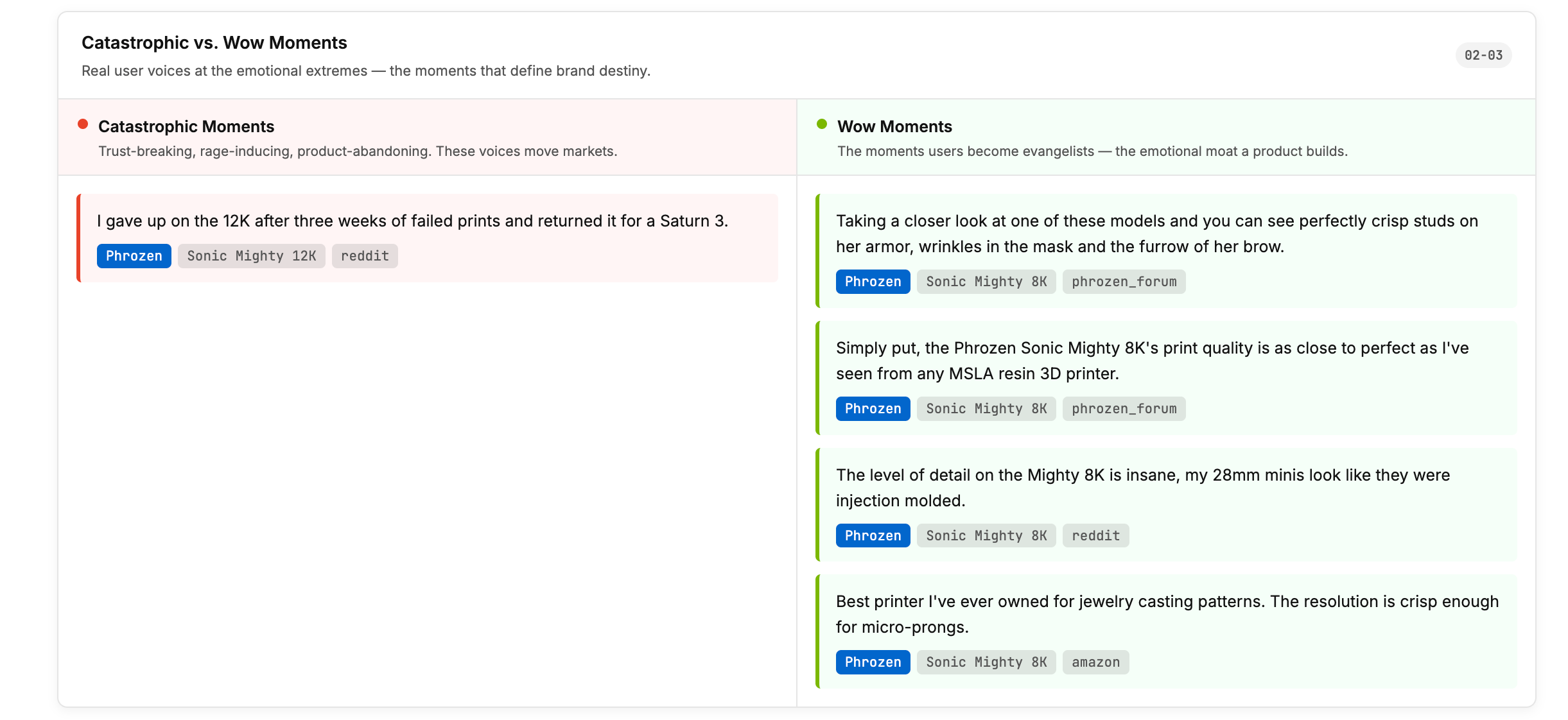
Phrozen appears here. 130 data points. 1 explicit complaint. 8% wow rate.
Users said:
"The level of detail on the Mighty 8K is insane, my 28mm minis look like they were injection molded."
"The Sonic Mighty 8K printed each of the details up to the T."
Phrozen users also complain about resin smell, delamination, and print failures. These are industry-baseline problems, not brand-specific failures.
This data surprised me. In lower price tiers, wow rates tend to inflate because expectations are calibrated low — users are easily impressed. But Phrozen's wow responses don't describe relief. They describe disbelief. "Insane detail." "Injection molded." That language is not low-expectation satisfaction. It is genuine precision delivery.
The users standing at this gate discussing 28mm miniature detail have already cleared the first four. That survival itself is a brand achievement.
The Market Rewards Patience, Not Specs
Post-processing → First layer adhesion → FEP management → Resin cost → Output quality.
Brands advertise gate five: stunning detail, impossible precision, injection-molded surface finish. Users get stuck at gates one through four: chemical cleanup, calibration loops, consumable accounting, ecosystem lock-in.
This is not a communication failure. It is a product definition failure.
Resin printing is not a device. It is a workflow. Every gate in that workflow is a place users can quit. The brand that reduces friction at the first four gates earns the right to sell precision.
The market doesn't reward what's on the spec sheet. It rewards whoever has patience left in their workflow.
lemon.wang | hi@lemon.wang
Note on Data: This analysis is based on the 2026Q2 Resin Insight dataset — 1,080 authentic user voices across 9 brands (Elegoo, Anycubic, Phrozen, Creality, HeyGears, Formlabs, Asiga, Prusa, Peopoly). Sources include Reddit, brand forums, YouTube, and Amazon. Some brand-level data requires access to view in full.
Source: Data processed via User's Voice, a competitive intelligence tool for the 3D printing industry.
- Resin Insight: resin-insight.usersvoice.lemon.wang
- FDM Multicolor: fdm-multicolor.usersvoice.lemon.wang
- iNew3D Full Color: inew3d.usersvoice.lemon.wang